Even highly successful organisations can hold substantial opportunities for greater enterprise value. Their functions may be capable, their leaders experienced and their results strong. Yet how those capabilities interact across the organisation can limit what the enterprise achieves as a whole.
Every organisation develops ways of accommodating the realities of operating at scale. Functions establish workarounds, experienced people bridge gaps, and leaders find ways to navigate competing priorities. Some arrangements are deliberate and effective. Others persist because they have become familiar, or because their wider consequences are not fully understood.
Strong results can conceal the effort required to sustain them.
A function may achieve its targets while transferring cost, effort or risk elsewhere. Poor cross-functional relationships can delay decisions or produce outcomes that are less effective for the enterprise. Where capability gaps or persistent underperformance remain unresolved, high performers may absorb additional responsibilities, leaving less capacity for innovation, developing others and creating new value.
The cost of accepted underperformance is not only the work left undone, but the greater value others are prevented from creating.
These consequences rarely appear together in a performance report. They are distributed across functions, absorbed into everyday operations and often accepted as part of how the organisation works.
When ambition places greater demands on the organisation
The significance of these conditions changes as an organisation grows, transforms or pursues more ambitious outcomes.
An effective operating model depends not only on its design, but on the decisions, capabilities, relationships and behaviours through which it operates. Even highly capable functions may struggle to realise their collective potential when their priorities, plans or decisions are insufficiently connected.
Equally, organisations need reliable management foundations. Leadership styles can and should vary, but essential disciplines—setting expectations, developing capability, addressing performance and working constructively across boundaries—cannot depend entirely on individual preference.
The challenge is not to eliminate every imperfection. It is to recognise which conditions are limiting the organisation's ability to achieve more, and whether its current ways of working remain sufficient for its future ambitions.
Understanding what produces enterprise performance
Artificial intelligence offers increasingly powerful ways to analyse organisational information, identify patterns and support decisions. Yet the system of work is shaped by more than what organisational systems record. Relationships and trust, incentives, culture, accumulated experience, commercial arrangements and external conditions all influence how work happens and outcomes are produced. These factors interact, often in ways that are not fully visible through available data or formal descriptions.
AI can help organisations investigate these interactions, but its insights depend on the information and context available to it. Understanding enterprise performance therefore requires deliberate inquiry into how work happens in practice, combining analytical capability with the experience, perspectives and judgement of those who work within and interact with the organisation.
The more capable our technology becomes, the more important it is to understand the organisation into which we are introducing it.
From visibility to greater enterprise value
Making enterprise performance visible is not about finding more problems or questioning everything that already works.
It is about understanding which conditions materially influence enterprise outcomes, recognising their wider consequences and identifying where improvement could create greater value.
For some organisations, that may mean strengthening fundamental management practices. For others, it may mean connecting already capable functions, decisions and resources in ways that unlock potential not apparent within individual parts of the business.
In either case, the opportunity extends beyond improving today's results.
A more complete understanding of how performance is produced provides a foundation for the organisation to become progressively better at improving itself.
That continuing ability to learn, adapt and create greater value in pursuit of its purpose is at the heart of Enterprise Performance.
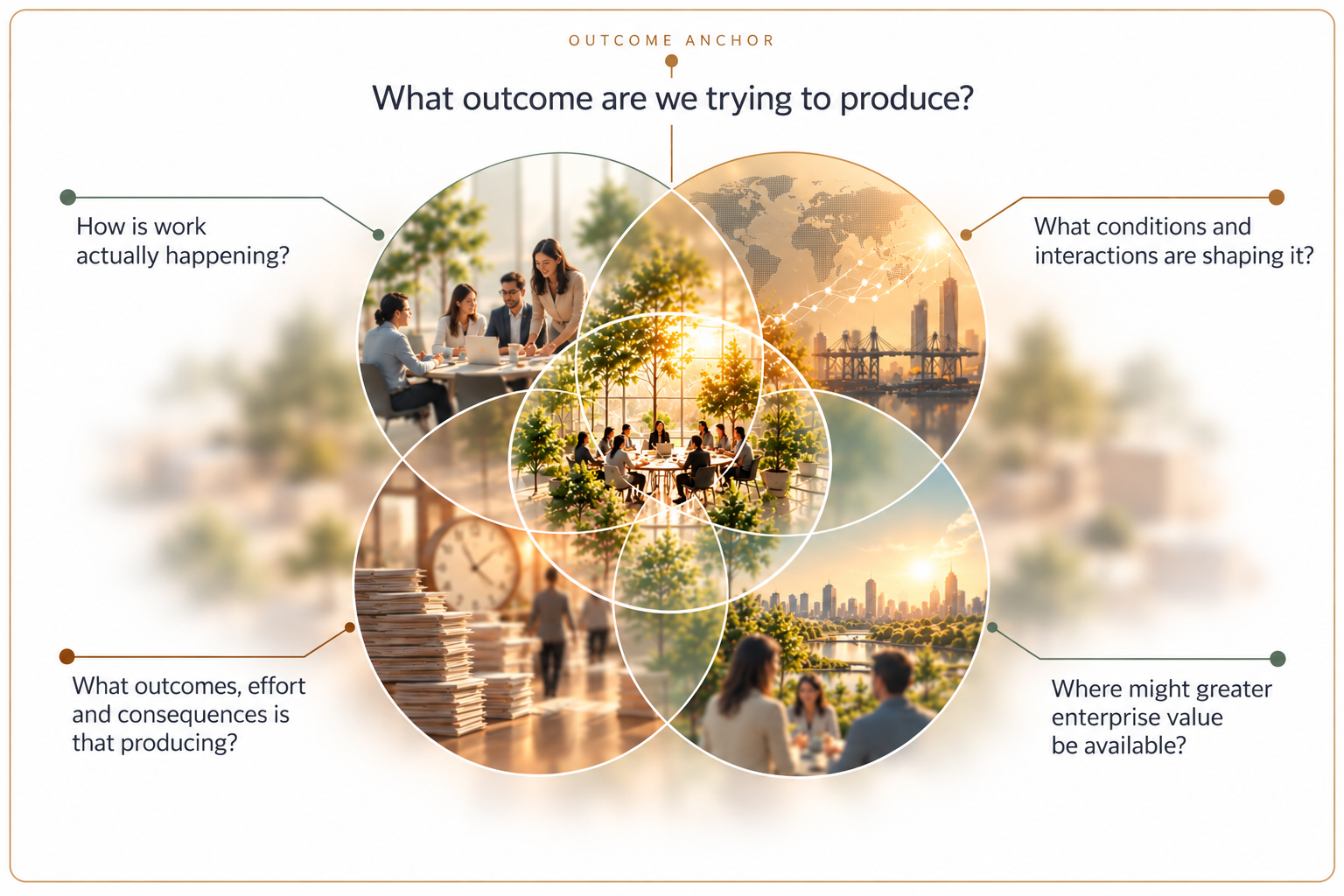
A lens for examining enterprise performance
Consider these perspectives together rather than individually. Where might their interactions be shaping the outcomes your organisation achieves—or limiting the value it could create?
ABOUT THE AUTHOR
Melanie Lisboa is an enterprise performance executive whose work focuses on how strategy, operating models, leadership, capability and execution combine to create value. Through Valde Enterprise Performance, she helps organisations develop the enduring capability to understand and deliberately improve how enterprise value is created.
© 2026 Melanie Lisboa. All rights reserved.
RELATED THINKING
The perspective presented in this essay reflects practical experience examining the conditions through which organisations produce performance. Established work on systems-based performance management, cross-functional effectiveness and organisational learning explores related ideas.
- W. Edwards Deming (1993) — The New Economics for Industry, Government, Education.
- Geary A. Rummler and Alan P. Brache (1990) — Improving Performance: How to Manage the White Space on the Organization Chart.
- Michael Beer and Russell A. Eisenstat (2000) — The Silent Killers of Strategy Implementation and Learning.
Banner image generated using Canva AI. Supporting diagram developed by Melanie Lisboa with assistance from OpenAI's ChatGPT.